
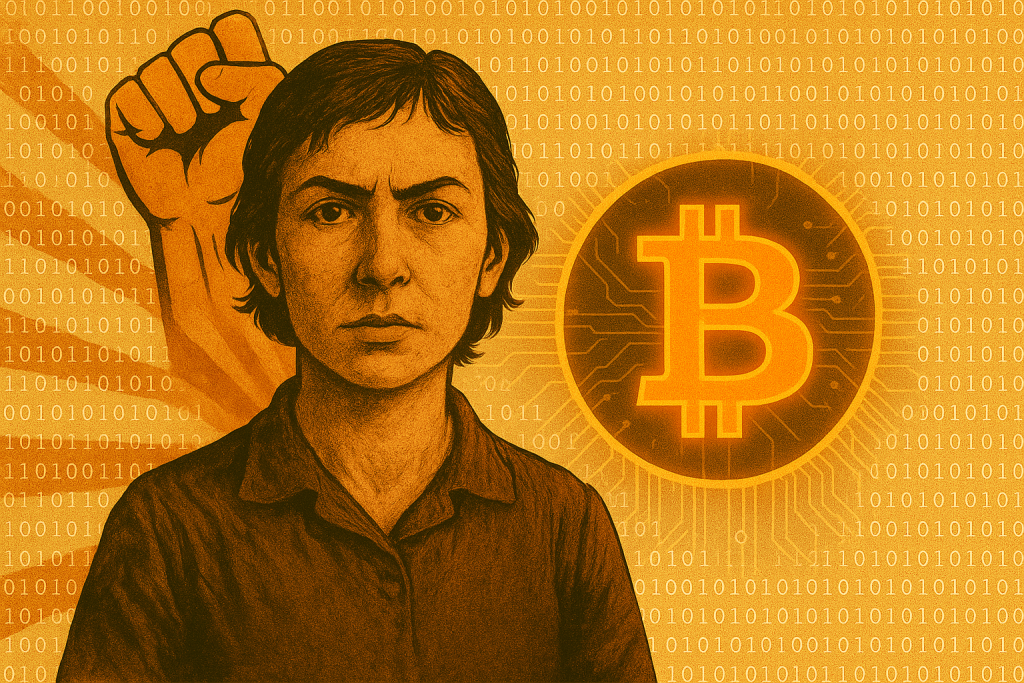
Before she became a hacker, a cypherpunk, or the figure later known as “St. Jude,” Judith Milhon was a civil rights activist in the segregated American South. That experience exposed her to injustice in its most visible forms—explicit discrimination, enforced segregation, and open coercion—but also to the quieter mechanisms that sustained it. Power, she learned, does not operate only through laws and violence. It also works through restricted access, constrained mobility, economic exclusion, and the routine denial of voice[1].
That early education appears to have shaped Milhon permanently. The record of her life and writing suggests she came to understand that informal systems—customs, credentials, bureaucratic norms, and social expectations—can be just as effective at enforcing injustice and exclusion as written law and physical force. She carried these insights with her when she later encountered computers, networks, and the emerging digital world. Technology, she seemed to grasp early on, would become another civil rights frontier[2].
To ask what St. Jude might think about Bitcoin is not to claim certainty or clairvoyance, but to offer an interpretation grounded in that history. The evidence of Milhon’s life suggests she would have taken Bitcoin seriously as a potential tool of liberation—while also subjecting it to the same scrutiny she applied to every technology capable of shaping human freedom.
Bitcoin did not exist in her lifetime. But the conditions that made it necessary did. And Milhon spent her life resisting precisely those conditions—whether they appeared in the open or were hidden behind the deceptive appearance of neutrality.
From the American South to the Digital Frontier
Milhon’s civil rights activism appears to have shaped her understanding of how power operates not only through laws and force, but through infrastructure. Working alongside movements for justice and African American equality, she likely came to see how access to banking, transportation, employment, and public institutions can be selectively constrained—sustaining inequality without the need for constant or explicit coercion[3].
The civil rights work in which Milhon participated was grounded in the practical labor of change: voter-registration drives, community organizing, logistical support for demonstrations, and coordination between local groups and national organizations. Participation in these efforts often exposed activists to harassment, surveillance by local authorities, economic retaliation, and the persistent threat of violence[4],[5],[6],[7]. While Milhon was not a nationally prominent figure within the movement, the available evidence suggests she worked at the level where ideals met reality—where progress depended on patience, discretion, and the ability to operate within hostile systems rather than merely denounce them from outside.
Crucially, civil rights organizing in the U.S. South was not only about confronting overt injustice and violence. It also required navigating the quieter mechanisms that enforced segregation and poverty: restricted access to public services, informal employment blacklists, financial exclusion, and bureaucratic obstruction. Activists learned how power could be exercised through paperwork, credentials, institutional gatekeeping, and selective enforcement—often with devastating efficiency and minimal visibility. This experience appears to have given Milhon a formidable education in systems of power, and it is difficult not to see a throughline from this period to her later skepticism toward centralized authority and her insistence that freedom requires more than moral commitment; it requires tools and structures that ordinary people can use without asking permission[8],[9].
When Milhon encountered computers in the 1970s, she appears to have recognized a familiar pattern. Modern computing and early networked systems were emerging from U.S. military and defense research, initially designed for command, control, and surveillance rather than broad civic participation[10]. At the same time, computing culture was becoming socially exclusionary—dominated by men, insulated by specialized jargon, and increasingly aligned with powerful institutions—even as it was publicly framed as neutral and apolitical. Evidence from Milhon’s writing and organizing suggests she worried that unless ordinary people, women, and marginalized communities were deliberately brought into these systems, computers and the internet would evolve less as tools for human agency and more as tools used on people[11],[12].
Rather than accepting that trajectory, Milhon taught herself to code and became a writer, editor, and organizer within early hacker culture. She rejected the emerging myth of the solitary male genius and argued instead—explicitly and repeatedly—for hacking as a social practice: collaborative, experimental, and ethically charged. Her call for women to “claim the keyboard” functioned not as a slogan, but as a strategy for building autonomy inside systems that otherwise defaulted to exclusion[13].
This worldview carried naturally into her engagement with the cypherpunk movement of the late 1980s and 1990s—a loose but intellectually formidable network of technologists, cryptographers, and activists who believed cryptography could serve as a practical defense of civil liberties in a networked world. Milhon moved in circles that included figures such as Eric Hughes and John Gilmore, among others who argued that in digital societies, rights would increasingly depend on code. Privacy, free association, and resistance to coercion would require technical tools, not only legal appeals[14].
Milhon did not live to see Bitcoin. But the evidence strongly suggests she helped cultivate the cultural conditions that made it imaginable: a world in which cryptography was understood not as a niche technical specialty, but as civic infrastructure—essential to preserving freedom in an increasingly mediated and digitized society.
Bitcoin as a Civil Rights Technology
If St. Jude could read the Bitcoin white paper today, it seems very likely—based on her lifelong commitments—that she would recognize something she spent her life reaching for: a working mechanism that reduces dependence on institutions to grant permission for economic participation[15].
Bitcoin’s most radical feature is permissionlessness. The network does not ask your gender, race, nationality, geolocation, or political alignment. If you can hold a private key, you can hold value. If you can broadcast a transaction, you can participate[16]. For someone shaped by civil rights struggle, this would not read as abstract technical elegance. It would register as a structural shift—a system designed to function without gatekeepers.
Milhon understood that money is inseparable from power. Monetary systems determine who can save without confiscation, who can transact without surveillance, who can leave abusive situations, who can fund dissent, and who can plan beyond the immediate present. Traditional financial systems routinely fail these tests—sometimes through deliberate design, sometimes through indifference, inertia, or bureaucracy. The result is the same: economic life mediated by discretion rather than by rules[17].
It is difficult not to hear an echo of these concerns in Bitcoin’s origin story. When Satoshi Nakamoto embedded the headline “The Times 03/Jan/2009 Chancellor on brink of second bailout for banks” into Bitcoin’s genesis block, it functioned as more than a timestamp. It was a quiet but unmistakable critique of a financial order that privatizes gains, socializes losses, and repeatedly insulates powerful institutions while exposing ordinary people to risk. Recording that dissent in code rather than commentary signaled an ethos Milhon would likely have recognized immediately: systems that shape human freedom must remain open to scrutiny, participation, and reform, not shielded by authority[18].
Bitcoin does not eliminate injustice, nor does it promise moral outcomes. What it can do is remove layers of discretionary control. It replaces trust in institutions with verifiable rules. In doing so, it offers a partial escape from inflationary debasement, capital controls, and politically motivated financial exclusion—conditions that are not theoretical abstractions, but daily realities for billions of people.
Bitcoin also fits squarely within the cypherpunk lineage that predates it. Proposals such as Wei Dai’s b-money[19], Nick Szabo’s bit gold[20], and Hal Finney’s reusable proof-of-work[21] circulated in the same intellectual ecosystems Milhon inhabited—spaces animated by the belief that cryptography could defend individual sovereignty in a networked world. Bitcoin did not emerge fully formed from nowhere; it arrived as an unexpected synthesis of decades of thought about how code might serve civil liberty[22].
Taken together, it is reasonable to think Milhon would have recognized Bitcoin as a rare thing: not a perfect solution, but a system that attempts to operationalize civil-liberty ideals at the level of infrastructure. For someone who spent her life insisting that freedom requires usable tools rather than benevolent institutions, that alone would have made Bitcoin worthy of very serious attention.
Where St. Jude Would Call for Deeper Work
At the same time, the record of Milhon’s life and work suggests she would rarely—if ever—offer uncritical endorsement of any technology, no matter how promising. Her instinct was to recognize liberating potential while insisting that culture, power, and participation ultimately determine whether that potential is realized or quietly undermined. She was not interested in purity tests or moral grandstanding, but she was deeply attentive to moments when a movement faced a choice about its direction.
From that perspective, it seems likely she would approach Bitcoin’s present moment with steady, constructive concern—not alarm, and certainly not condemnation, but with the seriousness of someone who understood how quickly freedom-enhancing tools can be bent toward other ends.
The first area where she would likely press Bitcoin forward is participation—particularly the need to broaden the circle to include more women. Bitcoin’s first seventeen years have unfolded much like earlier waves of science and technology: often animated by genuine openness and idealism, yet nonetheless heavily dominated by men[23]. This pattern is familiar and historically legible. It reflects long-standing differences in gendered access to technical education, confidence-building pathways, professional networks, and cultural reinforcement[24],[25],[26].
Milhon would almost certainly reject the framing of this as a moral failure. Instead, she would likely describe it as a moment of choice. The architecture of Bitcoin is universal by design; its culture can become more universal as well—but only through deliberate effort. Inclusion, in her view, would not be about optics or quotas. It would be about resilience and legitimacy. Systems grow stronger when more people understand them, use them, and feel entitled to shape them. Women’s participation in Bitcoin—as developers, educators, advocates, community builders, and everyday users—would therefore not be seen by her as a secondary concern, but a central pillar of Bitcoin’s long-term decentralization[27].
A second concern Milhon would likely raise is the risk that Bitcoin’s growing institutional adoption could slide into over-financialization and cultural passivity. She would probably view corporate and governmental engagement with nuance rather than panic, recognizing that some interaction with existing institutions is inevitable and that legitimacy can, in certain contexts, expand access. But she would also likely offer a firm reminder drawn from experience: decentralization does not fail all at once. It erodes gradually, when people stop learning how systems work, stop holding their own keys, stop running nodes, and stop seeing themselves as participants rather than customers[28].
From Milhon’s perspective, the danger would not be that institutions use Bitcoin, but that everyday people are subtly encouraged not to. When custody, understanding, and agency are outsourced for convenience, a technology designed to redistribute power risks reproducing the very hierarchies it set out to escape. Her response would not be to reject adoption outright, but to insist—forcefully—that education, self-sovereignty, and community-level participation remain central rather than optional[29],[30].
The third concern she would certainly push hard on is privacy.
Privacy was a foundational issue for Milhon and the cypherpunks (past and present). They understood privacy not as secrecy or criminal evasion, but as the precondition for free association, dissent, experimentation, and personal autonomy. Without privacy, other rights become fragile or performative. A society that treats privacy as suspicious, or that selectively criminalizes privacy-preserving tools, is one that steadily narrows the space for freedom[31],[32],[33].
Seen through that lens, it is difficult to imagine Milhon remaining quiet in the face of escalating attacks on financial privacy in the Bitcoin ecosystem—particularly the recent prosecution of the creators of Samourai Wallet in the United States[34]. To many cypherpunks and Bitcoiners, that case represents not the targeting of criminal behavior, but the criminalization of software that enables individuals to transact without constant surveillance. Milhon would likely see this as a dangerous precedent: an attempt to reassert control over peer-to-peer systems by intimidating developers and stigmatizing privacy itself[35],[36],[37].
Evidence from her writing and alliances strongly suggests Milhon would have pushed back adamantly against this trend. She understood that when privacy tools are treated as inherently suspect, the effect is not merely legal—it is cultural. Developers are encouraged to self-censor. Educators grow cautious. Ordinary users retreat. Over time, a system that was meant to empower individuals becomes safe only for those willing to operate under constant surveillance and threat.
Taken together, these three concerns—participation, decentralization, and privacy—form a coherent warning rather than a list of complaints. Milhon would likely argue that Bitcoin’s promise depends on holding and advancing all three simultaneously. A network that is technically decentralized but culturally narrow, financially captured, or hostile to privacy is one that risks losing the very qualities that make it worth defending.
Her push, I suspect, would be neither nostalgic nor reactionary. It would be forward-looking and practical: widen the circle, resist passive financialization, defend privacy without apology, and remember that liberation technologies remain liberating only when people are willing to actively inhabit them.
That, more than anything, is where St. Jude would push Bitcoin forward.
Heirs to St. Jude’s Legacy: Widening the Circle
If my interpretation is right, Jude Milhon would not measure Bitcoin’s health by its market capitalization, price cycles, or mere rates of adoption and use. She would look instead for signs of cultural and civic vitality: who is teaching and learning, who is building and maintaining, who feels welcome to participate, and who is actively bringing others into the system. For Milhon, the durability of any freedom technology depended less on scale than on whether people could meaningfully inhabit it.
By that measure, while there are still major obstacles to overcome, far more is happening within Bitcoin today than news headlines suggest. Around the world, many individuals and groups are quietly carrying forward the spirit of Milhon’s work on multiple fronts—defending decentralization against creeping centralization, standing up for privacy as a core civil liberty, and expanding participation beyond narrow technical or social circles. Much of this work is patient, local, and under-recognized, yet essential to Bitcoin’s long-term resilience.
This section turns its attention to one of the fronts Jude Milhon would have championed most insistently: widening the circle, particularly among women. The dozen women highlighted here are not listed as exceptions or symbolic figures, but as evidence that Milhon’s legacy is already being carried forward in concrete, consequential ways. As developers, educators, community builders, writers, and advocates, these women leaders are actively shaping Bitcoin’s culture, expanding its civic infrastructure, and lowering barriers to meaningful participation. Their work is unfolding across technical, educational, social, and cultural domains, often without the recognition it deserves. By naming and learning from these examples of leadership, the hope is to inspire an even broader expansion of leadership by girls and women around the world, across every facet of Bitcoin’s evolution.
Through their work, these women are strengthening Bitcoin not only as a network, but as a shared project—carrying forward the unfinished work that Judith Milhon began and extending it into a future still very much in formation.
Amiti Uttarwar
Amiti Uttarwar is the first confirmed female Bitcoin Core developer to receive funding to work full-time on the protocol, with a particular focus on improving Bitcoin’s peer-to-peer networking layer and strengthening user privacy. Trained as a software engineer and deeply embedded in open-source culture, Uttarwar has contributed to some of the most technically sensitive parts of Bitcoin’s infrastructure—work that directly affects decentralization, resilience, and censorship resistance[38],[39].
Gloria Zhao
Gloria Zhao is a Bitcoin Core maintainer whose work focuses on some of the most critical yet understated aspects of Bitcoin’s infrastructure, including mempool policy, transaction relay, and network-level defenses against censorship. As the first woman to become a maintainer of Bitcoin Core—the reference implementation of the Bitcoin protocol—Zhao occupies a role defined not by visibility but by responsibility, requiring long-term judgment, technical rigor, and trust from a global developer community. Her contributions are central to Bitcoin’s security and decentralization, ensuring the network continues to function reliably under adversarial conditions[40],[41].
Lorraine Marcel
Lorraine Marcel is a Kenya-based Bitcoin educator and financial activist and the founder of Bitcoin Dada, a women-centered initiative built to close the gender gap in Bitcoin across the African continent. The organization functions as both a “sisterhood” and an education pipeline—running online and in-person learning, community meetups, and programs that help women throughout different parts of Africa build practical Bitcoin skills and confidence. This includes a technical arm called Dada Devs. Marcel’s significance in the ecosystem is not only that she advocates for Bitcoin, but that she is building durable, local pathways for women to enter Bitcoin on their own terms—through education, mentorship, and community—providing a springboard for increased leadership by women in the future[42],[43].
Natalie Brunell
Natalie Brunell is a journalist, media host, and one of Bitcoin’s most effective public educators, known for her ability to translate complex monetary, technological, and geopolitical issues into thoughtful, accessible conversation. As the creator and host of Coin Stories, Brunell has interviewed many of the most influential thinkers in Bitcoin, economics, and public policy, consistently framing Bitcoin not as a speculative novelty but as a serious response to systemic monetary dysfunction. She is also the author of the recently published Bitcoin is for Everyone: Why our financial system is broken and Bitcoin is the solution[44],[45].
Charlene Hill Fadirepo
Charlene Hill Fadirepo is an educator, advocate, and community organizer who situates Bitcoin within the long history of racialized financial exclusion in the United States and throughout the African continent. Drawing on civil-rights traditions and contemporary economic data, her work emphasizes Bitcoin as a tool for community resilience, savings protection, and self-determination. In addition to her advisory work, she is the author of The Bitcoin Leap: How Bitcoin Is Transforming Africa, a co-author of the Bitcoin policy book, Bitcoin and the American Dream, and author of the Bitcoin children’s book, Sade’s Satoshis[46],[47].
Elizabeth Stark
Elizabeth Stark is a technologist, lawyer and educator. She is co-founder and CEO of Lightning Labs, where she has played a central role in advancing the Lightning Network—Bitcoin’s most prominent scaling effort aimed at enabling faster, lower-cost, everyday transactions. Trained in law and technology, Stark has long worked at the intersection of open networks, civil liberties, and infrastructure design, including earlier roles teaching internet law and advocating for decentralized protocols. Her leadership in Bitcoin scaling debates places her precisely where Jude Milhon believed participation mattered most: at the level where consequential architectural decisions are argued, tested, and built[48],[49].
Roya Mahboob
Roya Mahboob is an Afghan entrepreneur, human rights advocate, and one of the earliest global leaders to recognize Bitcoin’s potential as a tool for women’s empowerment under conditions of political repression. As the founder of Digital Citizen Fund, Mahboob pioneered the use of Bitcoin in Afghanistan to enable girls and women to receive payments for education and work at a time when traditional banking channels were inaccessible, unreliable, or actively dangerous. Her work demonstrated that Bitcoin’s value extends far beyond speculation: in environments marked by surveillance, capital controls, and gender-based exclusion, permissionless money can function as a lifeline for learning, autonomy, and dignity. Mahboob’s leadership sits squarely at the intersection of technology and human rights, embodying a principle Jude Milhon championed throughout her life[50],[51].
Reyna Chicas
Reyna Chicas is the Director of Education at My First Bitcoin, where she plays a central role in one of the most influential grassroots Bitcoin education initiatives in the world. Based in El Salvador, Chicas leads the development and deployment of open-source Bitcoin curricula designed to be accessible, rigorous, and adaptable across cultural and national contexts. Her work focuses on building foundational monetary literacy—helping students, teachers, and community members understand not only how Bitcoin works, but why sound money, self-custody, and financial sovereignty matter. Under her leadership, My First Bitcoin’s education model has expanded beyond classrooms into a global movement, with materials translated and used in dozens of countries[52],[53].
Suman Kumar
Suman Kumar contributes to Bitcoin primarily as a writer and cultural interpreter, helping articulate why Bitcoin matters beyond its technical properties. In her book Reclaiming Sovereignty: How I Fell in Love with BITCOIN, Kumar weaves personal narrative with political and economic reflection, connecting monetary autonomy to identity, agency, and self-trust. Her work expands Bitcoin’s intellectual and emotional vocabulary, making space for readers who may not arrive through engineering or finance but through lived experience and moral intuition. In addition to this work, Kumar is helping model Bitcoin education and use as a tool for empowerment in First Nations communities in Canada[54],[55].
Dr. Emma Apatu
Dr. Emma Apatu is a public-health professional, educator, and the founder of Dream Grad Academy, an organization focused on education, mentorship, and personal empowerment through Bitcoin as a powerful monetary determinant of health. Through her writing and teaching, Apatu explores the links between monetary instability, stress, health outcomes, and long-term community wellbeing, arguing that money is not merely an economic tool but a determinant of individual and public health. By introducing Bitcoin into conversations about resilience, education, and human flourishing, she broadens its relevance beyond finance and into the conditions of everyday life. Apatu is translating over a decade of university teaching experience at the University of North Florida and McMaster University into novel approaches to personal wellbeing and public health through Bitcoin[56],[57].
Thulisa Sikolpati
Thulisa Sikolpati is the founder and community lead of Bitcoin Loxion, a grassroots Bitcoin circular economy project based in Khayelitsha, one of South Africa’s largest townships, where many residents face persistent unemployment, limited access to formal banking, and the daily effects of currency instability and rising living costs. Through Bitcoin Loxion, Sikolpati works directly with local residents, small businesses, and community organizers to make Bitcoin usable in everyday economic life—earning, saving, and spending within the community rather than relying on extractive or costly financial intermediaries. In places like Khayelitsha, circular economies matter because they keep value circulating locally, reduce dependence on fragile institutions, and create unprecedented pathways for social and economic empowerment[58],[59].
Lyn Alden
Lyn Alden is a macroeconomic analyst, investor, and author whose work has become foundational for understanding Bitcoin within the broader context of monetary history, financial systems, and geopolitical change. Trained as an engineer and known for her rigorous, data-driven approach, Alden has played a central role in reframing Bitcoin not as a speculative anomaly, but as a rational response to structural weaknesses in modern monetary systems. Through her widely read research and her book Broken Money: Why Our Financial System Is Failing Us and How We Can Make It Better, she traces how layers of abstraction, leverage, and political discretion have eroded trust in money—and why a neutral, decentralized monetary network like Bitcoin represents a meaningful alternative[60],[61].
A Personal Note: Why This Matters to Me
I’m writing this not only as a Bitcoiner who believes deeply in Bitcoin’s revolutionary potential, but also as a father of two daughters. Some of my fondest memories with them are quiet ones—reading together at the end of the day, especially stories from Goodnight Stories for Rebel Girls[62]. Those books do something deceptively simple and profoundly important: they normalize the idea that women belong wherever history is being made. They make courage, curiosity, and leadership feel familiar rather than exceptional.
As I think about Bitcoin’s future, I find myself returning to that lesson. The technologies that shape freedom, opportunity, and dignity are never just technical; they are cultural. They are shaped as much by the stories we tell and who is participating as they are by the protocol itself. I want my daughters to grow up in a world where those tools are not quietly coded—socially or culturally—as being “for someone else.” I want them to feel entitled to learn hard things, to ask serious questions, to build, to lead, and to belong wherever the future is being made. I want the same for young girls around the world.
That is why widening the circle is not simply a secondary concern or a matter of optics as some might suggest. It is part of the project itself. Compendiums like those prepared by Rebel Girls must include the stories of the women who are already blazing trails with and through Bitcoin—as evidence of what participation can look like when barriers are lowered and curiosity is encouraged. These stories matter because they multiply. They provide pathways. They create continuity between those who came before and those who are just beginning to imagine themselves inside this movement. They help ensure that the next generation grows up knowing that the future of money, technology, and freedom is something they have every right to help shape.
Looking to the Future
Judith Milhon would almost certainly challenge the comforting assumption that Bitcoin’s permissionless design is, by itself, enough. Technical openness creates possibility, but it does not automatically dissolve the social, cultural, and economic barriers that shape who participates. Milhon understood—through civil rights organizing, early computing, and hacker culture—that power persists not only through formal rules, but through norms, confidence gaps, access to education, and unspoken expectations about who belongs. She would almost certainly insist that if Bitcoin is to remain a genuine “commons” rather than an informal club, its community must do more than point to the protocol. It must actively work to dismantle the structures of power that quietly limit participation, and to make the freedom Bitcoin offers usable, legible, and welcoming in practice.
This imperative extends beyond any single group or demographic: it applies across the vast richness of human experience—across cultures, geographies, abilities, economic circumstances, and identities the world over—because a system that is truly open must be inhabitable by all who seek to use it.
Bitcoin is public infrastructure. It belongs to no institution, profession, or demographic, and there is no single or correct way to begin engaging with it. People arrive through many paths: technical curiosity, economic necessity, intellectual inquiry, community work, or a desire for greater autonomy. Learning can begin quietly or socially, experimentally or systematically—by reading and listening, saving a small amount, attending a meetup, teaching a class, or asking questions in spaces where curiosity is met with patience rather than performance. Participation, in all its varied forms, is how freedom moves from abstraction into lived reality[63].
What feels especially consequential at this moment is the opportunity to see leadership continue to expand—across education, development, community-building, advocacy, and culture—particularly through the growing influence of women whose perspectives and experiences strengthen Bitcoin’s resilience and relevance. The examples highlighted here make clear that this leadership is already emerging in meaningful ways. Its impact extends well beyond representation. It shapes how Bitcoin is explained, how it is practiced, and who feels entitled to help guide its evolution.
Making this expansion possible is a shared responsibility. Cultures are shaped less by declarations than by tone, norms, and everyday behavior. Teaching without condescension, making space for different voices, supporting community-led education, and noticing subtle forms of exclusion when they arise all influence whether Bitcoin remains open in practice as well as in principle. Decentralization, in this sense, is not only a cryptographic property; it is sustained by the breadth of people who feel welcome to learn, use, and steward the system over time[64].
Bitcoin’s protocol is open. Its culture is still being formed.
And if Jude Milhon’s life teaches anything, it is that freedom technologies do not remain liberating by default. They remain so only when people choose—again and again—to widen the circle, to lower barriers, and to treat participation not as a privilege, but as a shared right and responsibility.
[1] Taylor Branch. Parting the Waters: America in the King Years, 1954–63. New York: Simon & Schuster, 1988.
[2] Steven Levy. Hackers: Heroes of the Computer Revolution. Garden City, NY: Anchor Press, 1984.
[3] Mehrsa Baradaran. How the Other Half Banks: Exclusion, Exploitation, and the Threat to Democracy. Cambridge, MA: Harvard University Press, 2015.
[4] Katie Hafner and John Markoff. Cyberpunk: Outlaws and Hackers on the Computer Frontier. New York: Simon & Schuster, 1991.
[5] John Dittmer. Local People: The Struggle for Civil Rights in Mississippi. Urbana: University of Illinois Press, 1994.
[6] Charles M. Payne. I’ve Got the Light of Freedom: The Organizing Tradition and the Mississippi Freedom Struggle. Berkeley: University of California Press, 1995.
[7] Danielle L. McGuire. At the Dark End of the Street: Black Women, Rape, and Resistance—A New History of the Civil Rights Movement. New York: Vintage Books, 2011.
[8] Steven Levy. Hackers: Heroes of the Computer Revolution. Op cite.
[9] Electronic Frontier Foundation (EFF). “Jude Milhon (‘St. Jude’) Oral Histories and Memorial Essays,” EFF Archives.
[10] Janet Abbate. Inventing the Internet. Cambridge, MA: MIT Press, 1999.
[11] Judy Wajcman. Technofeminism. Cambridge: Polity Press, 2004.
[12] Michael J. Halvorson. “Judith Milhon: Hacking on the edges of polite computing society”. Medium. March 27, 2021. https://halvormj.medium.com/judith-milhon-hacking-on-the-edges-of-polite-computing-society-5128e03ee141
[13] Katie Hafner and John Markoff. Cyberpunk: Outlaws and Hackers on the Computer Frontier. Op cite.
[14] Eric Hughes. “A Cypherpunk’s Manifesto.” 1993. https://www.activism.net/cypherpunk/manifesto.html
[15] Satoshi Nakamoto. “Bitcoin: A Peer-to-Peer Electronic Cash System”. 2008. https://bitcoin.org/bitcoin.pdf
[16] Andreas M. Antonopoulos. The Internet of Money, vol. 1. San Francisco: Merkle Bloom, 2016.
[17] Lyn Alden. Broken Money: Why Our Financial System Is Failing Us and How We Can Make It Better. Hoboken, NJ: Wiley, 2023.
[18] “Bitcoin Genesis Block,” Bitcoin blockchain data, block height 0, January 3, 2009; see also The Times (London), January 3, 2009, headline: “Chancellor on brink of second bailout for banks.”
[19] Wei Dai, “b-money,” 1998
[20] Nick Szabo, “Bit Gold,” ca. 1998–2005 (archived essays)
[21] Hal Finney, “Reusable Proofs of Work,” 2004.
[22] National Science Foundation. Women, Minorities, and Persons with Disabilities in Science and Engineering. Alexandria, VA: National Center for Science and Engineering Statistics, latest ed..
[23] Troy Cross and Andrew Perkins. Understanding Bitcoin Adoption in the United States: Politics, Demographics, & Sentiment. Nakamoto Project. Q3, 2025. https://cdn.prod.website-files.com/6644db90e58a1fbeb1c70ddc/685bdac1a0b3e8bb39ab854a_TNP%20Q3%202025%20Report.pdf
[24] Barbaño González. “Why Women Are Underrepresented in Open Source”. The New Stack. October 25, 2023. https://thenewstack.io/why-women-are-underrepresented-in-open-source
[25] Cheryl Robinson. “Women In Tech Stats: How The Industry Can Provide Equal Opportunities”. Forbes. June 18, 2024. https://www.forbes.com/sites/cherylrobinson/2024/06/18/women-in-tech-stats-how-the-industry-can-provide-equal-opportunities
[26] Elinor Ostrom. Governing the Commons: The Evolution of Institutions for Collective Action. Cambridge: Cambridge University Press, 1990.
[27] Yochai Benkler. The Wealth of Networks: How Social Production Transforms Markets and Freedom. New Haven, CT: Yale University Press, 2006.
[28] Andreas M. Antonopoulos. Mastering Bitcoin: Programming the Open Blockchain, 2nd ed. Sebastopol, CA: O’Reilly Media, 2017.
[29] Nick Szabo. “Trusted Third Parties Are Security Holes”, 2001. Nakamoto Institute: https://nakamotoinstitute.org/library/trusted-third-parties
[30] Lyn Alden. Broken Money: Why Our Financial System Is Failing Us and How We Can Make It Better. Op cite.
[31] Electronic Frontier Foundation (EFF), “Why Privacy Matters,” EFF.org, various essays and policy briefs
[32] Eric Hughes. “A Cypherpunk’s Manifesto,” 1993.
[33] Phil Zimmermann. The Official PGP User’s Guide. Cambridge, MA: MIT Press, 1995.
[34] United States Department of Justice. Press releases and indictments related to the Samourai Wallet case (2024). https://www.justice.gov/usao-sdny/pr/founders-and-ceo-cryptocurrency-mixing-service-arrested-and-charged-money-laundering
[35] Juan Galt. “The Samourai Wallet Trial: A Test of Financial Privacy and Developer Freedoms”. Bitcoin Magazine, December 10, 2025. https://bitcoinmagazine.com/politics/the-samourai-wallet-trial-a-test-of-financial-privacy-and-developer-freedoms
[36] Jenna Montgomery. “Filing Claims U.S. Prosecutors Knew License Wasn’t Required for Samourai Wallet, Prosecuted Them Anyways”. Bitcoin Magazine via Nasdaq. May 5, 2025. https://www.nasdaq.com/articles/filing-claims-us-prosecutors-knew-license-wasnt-required-samourai-wallet-prosecuted-them
[37] Nicholas Anthony. “Samourai Charges Mark Chilling Moment for Financial Privacy”. Cato Institute blog. April 30, 2024. https://www.cato.org/blog/samourai-charges-mark-chilling-moment-financial-privacy-0
[38] Rory Murray. “First Confirmed Female Bitcoin Core Developer Is True Face of the New American Dream”. Forbes. July 15, 2020. https://www.forbes.com/sites/rorymurray/2020/07/15/first-confirmed-female-bitcoin-developer-is-true-face-of-the-new-american-dream
[39] Harker. “Alumna Amiti Uttarwar ’10 named to Forbes 30 Under 30”. The Harker Magazine, December 3, 2020. https://news.harker.org/alumna-amiti-uttarwar-10-named-to-forbes-30-under-30
[40] Namcios. “Gloria Zhao Becomes First Female Bitcoin Core Maintainer, Pieter Wuille Steps Down”. Bitcoin Magazine. July 8, 2022. https://bitcoinmagazine.com/technical/first-female-bitcoin-core-maintainer
[41] “Gloria Zhao on Bitcoin Network Defense and Core Development”. Coin Stories, August 13, 2024. https://podcasts.apple.com/us/podcast/gloria-zhao-on-bitcoin-network-defense-core-developers/id1569130932?i=1000665129605
[42] Bitcoin Dada. “About Bitcoin Dada”. https://btcdada.com/about
[43] Frank Corva. “Lorraine Marcel: Bringing Bitcoin to African Women”. CoinDesk, March 19, 2024. https://www.coindesk.com/consensus-magazine/2024/03/19/lorraine-marcel-bringing-bitcoin-to-african-women?utm_source=chatgpt.com
[44] Natalie Brunell, primary website. https://talkingbitcoin.com
[45] Natalie Brunell. Bitcoin is for Everyone: Why our financial system is broken and Bitcoin is the solution. November 2025. https://lnk.to/bitcoinisforeveryone
[46] Charlene Hill Fadirepo, primary website. https://www.charlenefadirepo.com
[47] Charlene Hill Fadirepo. The Bitcoin Leap: How Bitcoin Is Transforming Africa. October 2024. https://www.amazon.ca/Bitcoin-Leap-How-Transforming-Africa/dp/B0DJX4HHF5
[48] Elizabeth Stark, Lightning Labs. https://lightning.engineering
[49] Leigh Cuen. “Bitcoin’s Warrior Queen: Lightning’s Elizabeth Stark Is Building an Army”. CoinDesk. December 31, 2018. https://www.coindesk.com/markets/2018/12/31/bitcoins-warrior-queen-lightnings-elizabeth-stark-is-building-an-army
[50] Alex Gladstein. “Finding Financial Freedom In Afghanistan”. Bitcoin Magazine. August 26, 2021. https://bitcoinmagazine.com/culture/bitcoin-financial-freedom-in-afghanistan
[51] Rina Chandran. “Salaries to remittances: Afghans embrace bitcoin amid financial chaos”. Reuters. October 11, 2021. https://www.reuters.com/world/salaries-remittances-afghans-embrace-crypto-amid-financial-chaos-2021-10-11
[52] My First Bitcoin. “Our Team”. https://myfirstbitcoin.org/the-project/our-team
[53] Reyna Chicas. “The Invisible Battle: Who Controls the Narrative of Bitcoin Education?”. BTC Prague presentation. https://www.youtube.com/watch?v=o_TsI6_8RtM
[54] Suman Kumar. Reclaiming Sovereignty: How I Fell in Love with BITCOIN. 2023. https://reclaimsovereignty.com
[55] “How Bitcoin Gave Me Back My Sovereignty”. Block Reward podcast. June 10, 2025. https://podcasts.apple.com/ca/podcast/88-suman-kumar-on-how-bitcoin-gave-me-back-my-sovereignty/id1708082630
[56] Dream Grad Academy. https://dreamgradacademy.com
[57] “From Fiat to Freedom: How Bitcoin is Re-Shaping a Nation’s Economy”. McMaster University Faculty of Health Sciences. https://globalhealth.healthsci.mcmaster.ca/from-fiat-to-freedom-how-bitcoin-is-re-shaping-a-nations-economy
[58] Bitcoin Loxion. “About Bitcoin Loxion”. https://bitcoinloxion.com
[59] Thulisa Sikolpati. “Bitcoin Loxion: Building a Bitcoin Circular Economy in Khayelitsha”. Presentation from Adopting Bitcoin, Cape Town 2025. https://youtu.be/_4eDjbyWHEo
[60] Lyn Alden. “Bitcoin: A Global Monetary Network”. Lyn Alden Investment Strategy. https://www.lynalden.com/bitcoin
[61] Preston Pysh. “Broken Money with Lyn Alden, Parts 1 and 2”. The Investor’s Podcast. https://www.theinvestorspodcast.com/episodes/broken-money-1-w-lyn-alden and https://www.theinvestorspodcast.com/bitcoin-fundamentals/broken-money-2-lyn-alden
[62] Elena Favilli and Francesca Cavallo. Good Night Stories For Rebel Girls. Rebel Girls, 2016. https://www.rebelgirls.com/products/good-night-stories-for-rebel-girls
[63] Paulo Freire. Pedagogy of the Oppressed. New York: Continuum, 1970.
[64] Elinor Ostrom. Governing the Commons. Op cite.

Scott A. Wolfe is Global Coordinator of the Federation of Bitcoin Circular Economies (FBCE), advancing financial inclusion and community socio-economic development around the world. Prior to this, Scott had a 20-plus year career in the not-for-profit health and community development sector, most recently for 15 years as Executive Director of the Canadian Association of Community Health Centres and International Federation of Community Health Centres. He also served, previous to that, with the International Association of Providers of AIDS Care in Chicago/Johannesburg and the Pan American Health Organization in Washington, DC. He is based in Toronto, Canada.