
There is an ongoing tension that runs through Bitcoin culture and the Bitcoin movement globally—one that is often misunderstood, but deeply felt.
Save it, or spend it?
For many Bitcoiners, the answer seems obvious. You save it. You never “sell” your Bitcoin. You accumulate. You stack sats. You don’t part with an asset that you believe will appreciate dramatically over time. Every sat sold or spent today is a sat you won’t have tomorrow. This disposition often dominates media narratives on a global scale.
And yet, this is only part of the story.
Across the world, there are growing numbers of people, in a vast array of countries and settings, who also understand Bitcoin’s characteristics and long-term value, but who spend it anyway. Not because they lack conviction, but because Bitcoin, for them, is not just an investment thesis. It is money. Better money. Money that works.
This is where the real tension lies—not between those who understand Bitcoin and those who don’t, but between two ways of expressing that understanding.
In countries like Canada, the United States and much of the so-called Global North, Bitcoin is overwhelmingly experienced as a store of value, as savings, as an investment. Whether it is self-custodied, held on an exchange, or held via a Bitcoin exchange traded fund (ETF), it sits alongside other investments. It is allocated to portfolios. It is measured against charts and models.
Even among the most committed Bitcoiners, spending it can often feel counterintuitive or unnatural. There are practical reasons for this: limited merchant adoption in many places, a lack of education about using Lightning, Liquid or other Layer 2 solutions to easily spend BTC, and the simple reality that most everyday transactions are still denominated in fiat currencies. There is also something deeper: a reluctance to let go of something that feels increasingly scarce and important.
On the other hand, there are other places around the world—predominantly in the so-called Global South, so far—where Bitcoin is experienced more as a medium of exchange, as everyday money. Through my work with the Federation of Bitcoin Circular Economies (FBCE) [1] and with local Bitcoin Circular Economy projects around the world, I see everyday how Bitcoin is being used to buy food, pay wages, run small businesses, and build local resilience. In these contexts, the question is not whether Bitcoin is a good long-term investment. The question is whether it works—right now—as a better form of money than what people already have.
And increasingly, the answer is yes.
Platforms like BTC Map are making visible what was once invisible: a growing, global network of merchants who accept Bitcoin as payment. Companies like MoneyBadger in South Africa and Tando in Kenya are building real infrastructure that enables everyday commerce in Bitcoin. Other businesses like Bitcoin Travel and AirBTC are bringing Bitcoin payment to other distinct areas of commerce and daily life at a global scale. These are not theoretical experiments. They are functioning economic arteries—more of them emerging month by month—where Bitcoin flows [2].
From that vantage point, the idea that Bitcoin should not be spent can feel not just misguided but embarrassingly disconnected from reality.
These are not opposing ideologies. They are different responses to different social and economic realities.
But as Bitcoin matures, these realities are beginning to overlap, more and more, and across different regions of the world.
The Missing Link
I remember standing in a small shop in the town of El Zonte, on the south coast of El Salvador, watching several customers ahead of me pay for items with Bitcoin. The transactions were quick—almost unremarkable. No ceremony. No hesitation. Just a scan, a confirmation, and life moved on. The same when it came to my turn to pay—a ten second transaction which included a simple QR code on the point-of-sale terminal and processing payment from the Bitcoin Lightning wallet on my phone. Just as easy as tapping a credit card or clicking an ApplePay type transaction.
I asked the merchant what they did with the Bitcoin they received.
“Some I keep,” they said. “Some I spend.”
That was it.
No debate about timing the market. No anxiety about whether this was the “right” moment to spend. Just a natural integration of saving and using—of holding and circulating.
That simplicity stayed with me. Because in much of the so-called Global North, we have built something far more complicated.
We have internalized a version of Bitcoin that emphasizes accumulation but have under-emphasized its usage. We understand its value, but we hesitate to express that understanding in our daily economic lives. The result is a subtle imbalance.
If Bitcoin is only saved and rarely spent, it risks becoming economically inert. It may continue to appreciate in price measured in fiat terms, but it does not circulate. It does not integrate into daily commerce. It does not challenge fiat currencies at the level where they are most deeply embedded: everyday transactions.
At the same time, the hesitation to spend is not without merit. Bitcoin’s long-term appreciation is one of its defining features. Asking people to simply “use it more” without addressing that concern is unlikely to gain traction.
What is needed is not a trade-off, but a bridge.
Spend and Replace
That bridge is simple in concept, but powerful in practice: Spend and Replace.
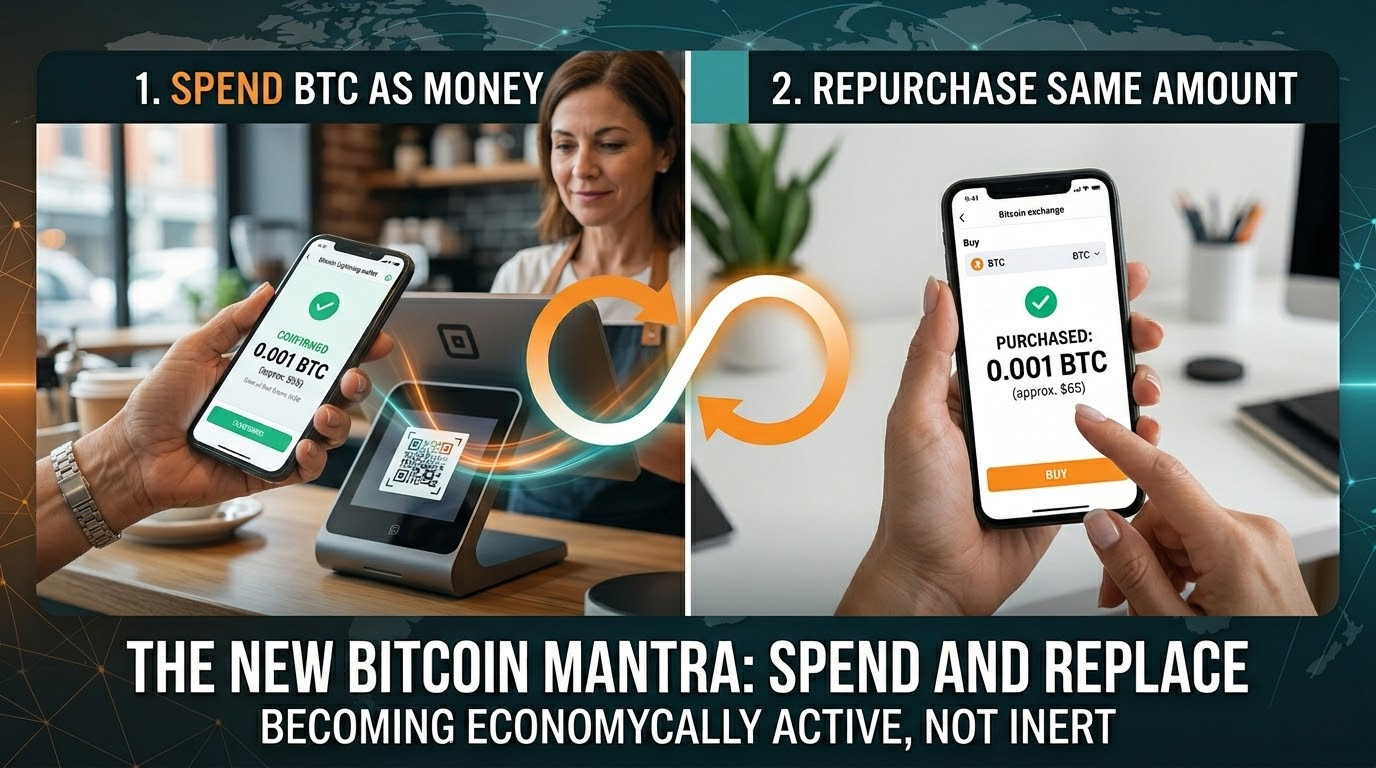
To spend and replace your Bitcoin is to use it as money whenever and wherever possible—paying for goods and services in sats—but then to repurchase that same amount shortly afterward, restoring your savings position.
You are not “giving up” your Bitcoin. You are putting it to work.
I’ve seen many versions of this already emerging informally. Bitcoiners buying a meal with sats, then later that day or week buying back the equivalent amount. Not perfectly. Not systematically. But intuitively.
What happens when that behavior becomes intentional? What happens when it becomes a universal mantra among Bitcoiners worldwide, right up there alongside “stay humble, stack sats”?
Everything changes.
This approach resolves the core tension. It allows Bitcoin to function as both a store of value and a medium of exchange—not in theory, but in lived practice, everywhere.
And importantly, it introduces something that Bitcoin still needs more of in many parts of the world: visibility and movement.
When Bitcoin moves—when it is spent, received, and re-spent—it becomes visible. Merchants begin to notice. Payment providers begin to adapt. Individuals who may have only heard of Bitcoin begin to encounter it in real transactions. Some merchants will convert immediately to fiat. Others won’t. Some will hold a portion. others will begin to study it for the first time.
Circulation is education. And education is adoption.
A Moment That Matters
This idea arrives at a particularly important moment.
With Square’s rollout of Bitcoin payments across its point-of-sale terminals in the United States—and its announcement that Bitcoin acceptance will become a default option across all terminals as of March 30, 2026—we are witnessing a meaningful shift in infrastructure and opportunity [3].
For the first time, millions of merchants across a major economy in the so-called Global North will have the built-in capability to accept Bitcoin.
A café owner may wake up that morning not fully realizing that they can now accept sats. A Bitcoiner may walk in that morning and simply select the native BTC option and process payment in Bitcoin, prompting the merchant to appreciate that Bitcoin is now part of the default payments and financial landscape.
This moment matters. Because adoption does not begin with certainty. It begins with curiosity, followed by use.
Infrastructure alone, however, does not create adoption. Behavior does.
From Slogan to Movement
Since its launch in 2009, Bitcoin has been shaped heavily by culture.
Phrases like “not your keys, not your coins”, “hodl”, and “stay humble, stack sats” have done more than communicate ideas—they have coordinated behavior across a decentralized global network.
But culture evolves. It also forms branches.
And at this stage in Bitcoin’s development, a new complementary mantra is emerging—one that builds on the foundation of saving, but extends it into action:Spend and Replace.
This is not a rejection of saving. It is its completion. It is what happens when conviction matures into participation.
The Next Phase
In many parts of the world, Bitcoin is already money. Eight year-old school children are adept masters of its use when compared to the average suit-and-tie Bitcoin guru who pops up on CNBC, Bloomberg, or BBC.
Projects mapped through BTC Map, and enabled to scale by MoneyBadger, Tando, and many other Bitcoin-based scaling businesses, demonstrate that Bitcoin-based economies are not hypothetical—they are operational. What has been missing is not proof of concept, but broader participation in places where Bitcoin adoption has, until now, been driven primarily by the investment thesis.
That is beginning to change, and the pace is accelerating. The tools are improving. The infrastructure is expanding. And the opportunity to bridge saving and spending is becoming more accessible.
The question is no longer whether Bitcoin can be money. The question is whether more people are willing to use it that way.
A Call to Action
So here is the invitation. Not someday. Now!
If you are a Bitcoiner in the United States, treat March 30, 2026, as a starting point. Walk into businesses with Square terminals. Select the Bitcoin option for payment and use it.
Spend sats. And then replace them. Do it again the next day. And the next week. Do it consistently.
If you are in Canada, in Europe, in Australia, or elsewhere—do the same, wherever the opportunity exists. If you see a Square payment terminal, see if the BTC payment option is live. Use it. If not, ask the merchant if they will accept Bitcoin. Seek out other merchants that accept Bitcoin. Support them. Help make Bitcoin visible in your local neighbourhood and town.
This is how circular economies begin. Not through large, coordinated programs—but through repeated individual action.
A Mantra for the Moment
Stay humble, stack sats helped Bitcoiners learn how to save and be part of a shared vision and community.
Spend and Replace can help Bitcoiners learn how to spend and build the global Bitcoin-based economy.
Together, they form a complete monetary practice.
Save in Bitcoin. Spend in Bitcoin. Replace what you spend.
Repeat. Repeat. Repeat.
Monetary transitions do not happen all at once. They happen gradually, through repeated behavior. Through millions of small decisions that, over time, reshape expectations and realities. To spend and replace is one such decision. It is simple. It is practical. And it is available to anyone who holds Bitcoin today.
The future of Bitcoin will not be determined solely by how much is held. It will be shaped by how it moves and how it transforms communities.
Endnotes
- Federation of Bitcoin Circular Economies (FBCE) https://fbce.io
- BTC Map “Global Bitcoin Merchant Map” https://btcmap.org/map; MoneyBadger https://www.moneybadger.co.za; Tando https://www.tando.me; Bitcoin Travel https://bitcointravel.com; AirBTC https://airbtc.online.
- LiveBitcoinNews. “Bitcoin Payments Set To Go Live By Default For Square Merchants Globally”. March 18, 2026. https://www.livebitcoinnews.com/bitcoin-payments-set-to-go-live-by-default-for-square-merchants-globally

Scott A. Wolfe is Global Coordinator of the Federation of Bitcoin Circular Economies (FBCE), advancing financial inclusion and community socio-economic development around the world. Prior to this, Scott had a 20-plus year career in the not-for-profit health and community development sector, most recently for 15 years as Executive Director of the Canadian Association of Community Health Centres and International Federation of Community Health Centres. He also served, previous to that, with the International Association of Providers of AIDS Care in Chicago/Johannesburg and the Pan American Health Organization in Washington, DC. He is based in Toronto, Canada.