
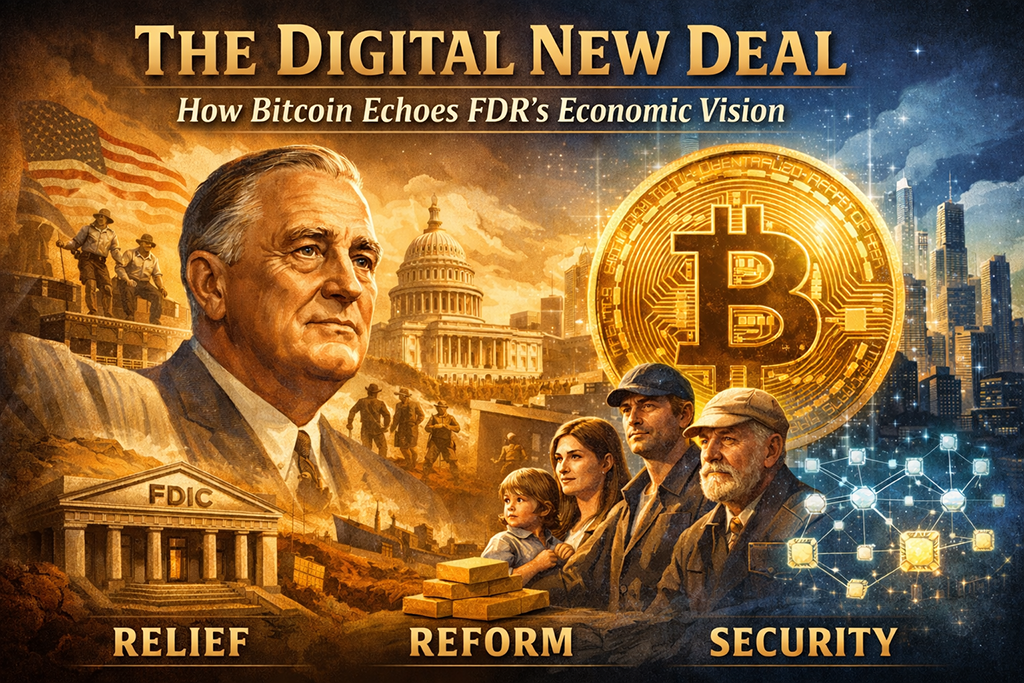
In the spring of 1933, Franklin D. Roosevelt took office during a period of existential economic crisis. His New Deal was built on the “Three Rs”: Relief, Recovery, and Reform. While Roosevelt’s methods were rooted in centralized federal intervention, his core objective was to rescue the American worker from a financial system that had failed them.
Today, nearly a century later, Bitcoin has emerged as a decentralized technological force. While often viewed through a libertarian lens, Bitcoin’s underlying ethos shares a surprising resonance with the New Deal philosophy—specifically in its drive to protect the “forgotten man” from the systemic failure of financial institutions to address their needs.
Financial Inclusion as “Relief”
FDR’s New Deal was a response to a banking system that had locked out ordinary citizens. The creation of the FDIC was meant to give regular Americans the confidence that their savings were safe from the mismanagement of distant bankers.
Bitcoin operates as a modern digital version of this safety net. For the unbanked and underbanked—those currently ignored by traditional financial institutions—Bitcoin offers financial sovereignty. It provides a way to store value and participate in the global economy without needing permission from a centralized authority, effectively providing “relief” from the barriers of entry inherent in the legacy banking system.
Sound Money as “Reform”
A central tension in the New Deal was FDR’s decision to move away from the gold standard (notably via Executive Order 6102) to give the government the flexibility to stimulate the economy. However, the intent of his financial reforms, such as the Glass-Steagall Act, was to separate speculative gambling from essential commercial banking.
Bitcoin serves as a “reform” by programmatic design. Its fixed supply of 21 million coins creates a transparent, predictable monetary policy that cannot be altered by political whim. In an era of high inflation, Bitcoin offers a “sound money” alternative that protects the purchasing power of the average citizen, echoing FDR’s goal of creating a financial system that serves the public interest rather than the interests of speculative high-finance.
Economic Security for the “Forgotten Man”
FDR famously spoke of the “forgotten man at the bottom of the economic pyramid.” The New Deal sought to create social security—a baseline of stability that would prevent the elderly and the vulnerable from falling into abject poverty.
In a global context, Bitcoin provides a similar form of economic security. In nations where local currencies are destroyed by hyperinflation, Bitcoin is often the only tool available for families to protect their life savings. By removing the “middleman,” Bitcoin empowers the individual to hold their own wealth, mirroring the New Deal’s ambition to shift power back into the hands of the people.
Infrastructure for a New Era
Just as the Tennessee Valley Authority (TVA) and the Works Progress Administration (WPA) built the physical infrastructure—dams, bridges, and roads—necessary for a 20th-century economy, Bitcoin and its underlying blockchain represent a new kind of digital infrastructure.
TVA/WPA: Modernized the American landscape through public works.
Bitcoin Network: Modernizes the global financial landscape through a secure, public, and open-source ledger.
This “Digital New Deal” provides a neutral platform for innovation, allowing for faster, cheaper transactions and a more transparent way to verify ownership in a digital-first world.
A Convergence of Intent
While FDR believed in the power of the State to fix the economy and Bitcoin believers trust the power of Code, both movements were born from the same frustration: a belief that the existing financial order was serving the few at the expense of the many.
By prioritizing transparency, access, and protection against systemic collapse, Bitcoin may be the most significant “New Deal” of the 21st century—not as a government program, but as a public utility for the digital age.